King Arthur
Sir Gawain and the Green KnightKing Arthur is the ruler of Camelot and the presiding figure of the court where the poem’s adventure begins. Presented as the finest of Britain’s kings and as a lively, youthful host, he receives the Green Knight’s challenge with courtesy rather than fear. His court gives the narrative its point of departure: Sir Gawain leaves its fellowship for an ordeal whose meaning will be disclosed only after he returns.
Identity and Court
The narrator introduces Arthur through the reputation of Britain’s kings, calling him their finest, and announces that the tale will recount an extraordinary adventure associated with his wonders. This framing makes Arthur more than a background monarch: his court is the celebrated setting from which the story’s marvels emerge, and his name lends the opening episode the stature of a royal adventure.
At Christmas, Arthur sits at Camelot among many gracious lords and the distinguished brothers of the Knights of the Round Table. The gathering establishes a world of fellowship, ceremony, and abundance before the Green Knight’s arrival disrupts it. Arthur’s behavior at the feast is notably youthful and sociable. He will not eat until everyone has been served, and the narrator describes him as cheerful and somewhat childlike. The detail combines the obligations of a ruler and host with a buoyant temperament: Arthur observes the order of the feast, yet the scene also presents him as eager for its pleasures and company.
The Challenge at Camelot
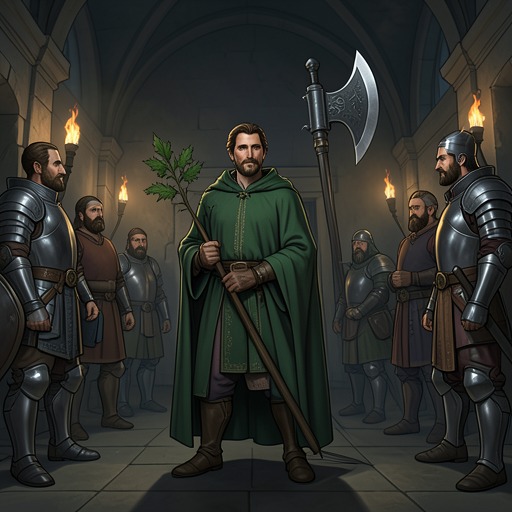
When the Green Knight appears, Arthur watches the extraordinary visitor from before the high dais and treats him courteously, showing no fear. As the assembled company grows angry, Arthur himself stands near the formidable stranger and speaks. The contrast matters: the challenge unsettles the court, but Arthur’s response is neither withdrawal nor panic. He maintains the role of host and ruler in the very moment when the customary safety of the feast is broken by an impossible visitor and his demand.
The poem describes this as an adventure received by Arthur in his youth, when he longed to hear boastful accounts. That retrospective description connects the king’s appetite for marvels with the arrival of the challenge. The adventure is not simply imposed on an unwilling court: the narration presents Arthur as a young ruler whose desire to hear of daring exploits makes such an encounter fitting. The challenge, however, passes from the king to Sir Gawain, who becomes the knight charged with carrying its consequences beyond Camelot.
The Court as Departure and Return
Arthur’s importance to the plot is clearest in the structure of the journey. The adventure begins amid the Christmas fellowship of Camelot, but its tests unfold elsewhere, beyond the familiar court. Sir Gawain’s departure therefore carries the Round Table’s ideals into a world where courtesy, courage, and self-preservation will be tested under pressure. Arthur remains the courtly point of reference for that movement, rather than the participant in the later trials.
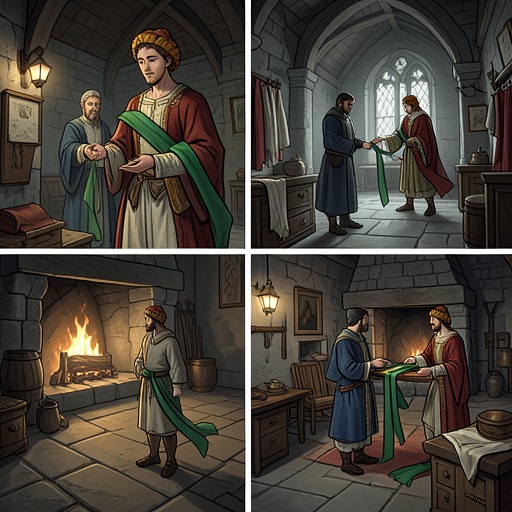
The narrative eventually returns Gawain to the court. On his arrival, the company wakes and rejoices that he has come back safe. This reception gives the return a communal dimension: the ordeal undertaken by one knight is received by the fellowship from which he set out. The account does not describe a separate exchange between Arthur and Gawain at that moment, so Arthur’s role is best understood through the court as a whole, whose welcome restores the returning knight to the world of Camelot.
Narrative Significance
Arthur anchors the poem’s opening in the conventions of a courtly adventure: a great ruler, a Christmas assembly, and an unexpected marvel that sets a knight in motion. Yet the tale’s attention shifts quickly from the king who receives the challenge to the knight who must live through its consequences. Arthur’s youthful eagerness helps establish the atmosphere of wonder, while the court’s later welcome marks the journey’s return to its starting community.
The final disclosure of the challenge’s making also alters how the opening encounter can be understood. The Green Knight identifies himself as Bertilak of Hautdesert and says that the affair came about through the power of Morgan le Fay, who lives in his house. Arthur is not present for that disclosure, but it reveals that the marvel introduced at his court belongs to a design extending beyond the court’s knowledge. His position in the narrative is thus both central and bounded: Camelot is where the adventure begins and where Gawain returns, while its hidden causes and moral tests lie outside Arthur’s immediate view.